The ROI of founder personal brand building is measurable, faster than most founders expect, and can exceed what paid advertising usually produces at the same budget. For instance, across our structured personal brand programme projects, B2B founders consistently achieve 7-18x growth in LinkedIn impressions within 90 days, alongside direct pipeline effects: more qualified conversations, higher conversion rates, and inbound opportunities that didn’t exist before.
Most founders who are skeptical of personal brand building have never seen it done with a strategy behind it. They’ve seen the LinkedIn equivalent of shouting into a void: motivational quotes, vague industry commentary, the occasional humble-brag milestone post. They’ve tried it themselves, found it awkward and time-consuming, and concluded it doesn’t work.
What they haven’t seen is what happens when a founder builds their presence from the inside out. With clear positioning, an authentic voice, and a content system that doesn’t require reinventing everything from scratch every week.
The data from that version of personal branding is different. Significantly different.
Why founders (not just their companies) need a personal brand in 2026
The shift in how B2B buyers research vendors has fundamentally changed what a founder’s public presence is worth.
LinkedIn users are 3x more likely to engage with content that features a CEO or founder than with equivalent content from a company page. 59% of B2B decision-makers prefer creator content on LinkedIn over other platforms, and 82% say this content influences their purchasing decisions.
This is a clear structural shift in how enterprise buyers evaluate vendors. Before a prospect agrees to a call, they’ve already looked you up on LinkedIn, read your last few posts, and formed a preliminary view of whether you’re credible. Your personal brand is now part of the sales process whether you’ve intentionally built it or not.
For early-stage B2B startups in particular, the founder’s personal credibility often compensates for institutional credibility the company hasn’t yet built. When there’s no ten-year track record, no Fortune 500 client list, no analyst coverage, the founder’s voice is the brand.
LinkedIn generates 80% of all B2B leads from social media, surpassing Facebook, X, and Instagram combined. If you’re a B2B founder not building a presence there, you’re absent from the channel where your buyers are making decisions.
What the data shows: 3 founder personal branding cases
The following results come from structured personal branding work by InnoMaker Partners. All names are anonymised. The metrics are real.
Case 1: pre-seed SaaS startup, during market entry
Situation: A founder with very low public presence in their target market. The company was unknown. Strong product, no visibility. Even despite publishing personal content.
Approach: A structured personal brand programme covering positioning, authentic narrative, content system, and LinkedIn presence, delivered over 3 months.
Results:
+1,800% increase in LinkedIn impressions
A single organic post reached 20,000+ impressions, drawing significant investor attention
Within 4 weeks: top 50 ranking on a national startup list
#2 position in category on a major European startup database
All of this was achieved organically. No paid advertising. The country in question has approximately 10 million inhabitants, making the impression-to-TAM ratio extremely significant.
Case 2: B2B founder at an AI company, first 90 day
Situation: A founder had been posting independently for months with limited results. Their first two weeks on our structured programme outpaced the previous three months of solo effort.
Results in 90 days:
+1,330% more impressions
+8,300% more saves and shares
+344% more engagement
+700% increase in website clicks from LinkedIn content
+20% more new followers
The +8,300% increase in saves and shares is the metric that matters most here. That’s content being bookmarked and forwarded by other professionals, which is distribution happening without additional effort from the founder.
Case 3: nine-month internal pilot on our own methodology
At InnoMaker Partners, one of our co-founders, after frequent posting on his own, ran our personal brand methodology on themselves over nine months, both as a test of the system and as a proof point for clients.
Results over 9 months:
+102% more impressions
+109% total engagement growth
+119% more comments
+45% higher average engagements per post
+8.4% improvement in engagement rate
These are sustained, compounding results, and not a single spike. The consistency of the growth pattern reflects what structured personal branding produces over time: not a viral moment, but a steadily expanding audience that engages with increasing depth.
How personal branding ROI translates into business results
Founders rightly ask: impressive as the impression numbers are, do they produce business results? Yes. But through several mechanisms simultaneously, not just direct inbound leads.
Trust before the first conversation:
When a prospect has read ten posts from you before they get on a call, they arrive with a baseline of trust that changes the entire sales dynamic. Qualification questions are different. Conversion rates are different. Sales cycles are shorter. This is hard to attribute to a specific post, but it’s consistently reported by founders who’ve built genuine presence.
Inbound opportunities that don’t show up in standard analytics:
Distribution partners, investors, press, and potential clients mention founders to each other, and a strong public presence makes that referral credible. You can’t attribute this to a post, but it compounds over time in ways paid acquisition doesn’t replicate.
Differentiation in competitive processes:
When two startups are shortlisted, the one whose founder has a credible, thoughtful public voice often wins. Buyers at the early stage are buying into the person as much as the product.
Talent and ecosystem attraction:
Senior hires research the people they’re considering working for. Partnership and distribution conversations benefit from a founder who’s demonstrably known and respected in the space.
Posts with a personal story or lesson learned get 38% more engagement than promotional posts, and “How I…” posts generate 3x more saves than listicles. The ROI of authenticity is built into the platform’s algorithm, which is why generic thought leadership produces mediocre results and genuine perspective produces disproportionate reach.
Why founder personal branding fails often
The most common failure mode: starting from the wrong question. Asking “what should I post?” before asking “what do I actually stand for and why?”
When you start from content formats, you get content that feels manufactured. It requires constant creative effort because there’s no underlying structure to draw from. It produces the “cringe” outcome that puts founders off in the first place.
The second failure mode is inconsistency. A personal brand that posts for three weeks then goes quiet for a month doesn’t build the compounding effect that makes the investment worthwhile. LinkedIn creators who engage meaningfully within the first hour of posting see 2x more total impressions. Posting 2-3 times per week generates significantly stronger results than sporadic activity.
Consistency requires a system, a framework that makes content creation repeatable rather than a creative act from scratch every week. Without that system, even motivated founders eventually stop.
The three factors that determine an authentic personal brand
At InnoMaker Partners, we’ve built personal brand programmes for founders across industries: materials technology, vertical AI, SaaS (B2C and B2B). The methodology starts with three questions:
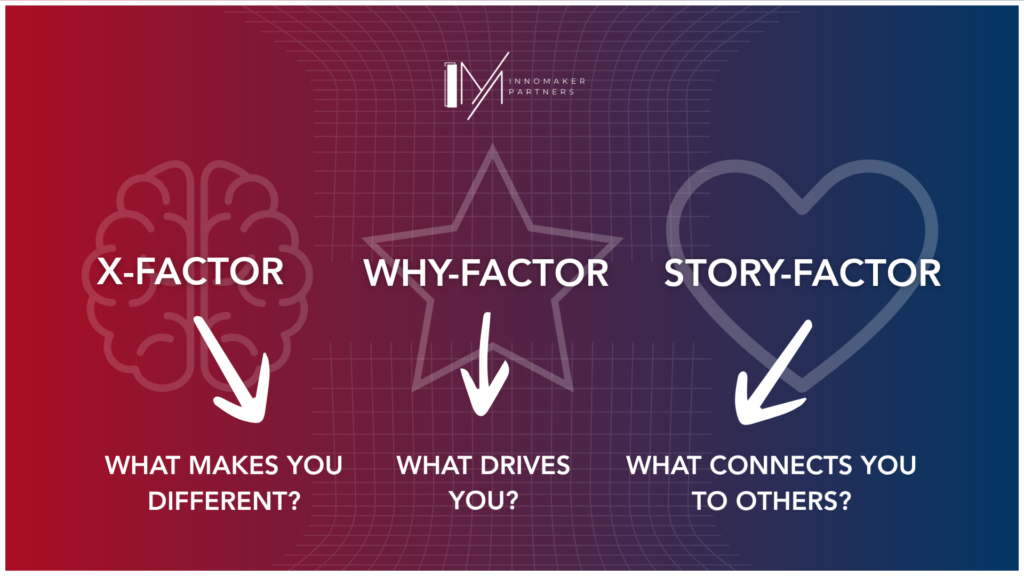
X-Factor: What makes you different? Not your company’s marketing differentiation, but what genuine perspective, experience, or characteristic sets you apart from others in your space?
Why-Factor: What drives you? Not the mission statement, but the actual reason. Audiences detect the difference between a rehearsed answer and a real one, and the algorithm rewards the real one.
Story-Factor: What connects you to others? The specific experiences, pivots, lessons, and failures that make your journey relatable, not just impressive.
These three factors combine to produce a brand that is authentic by construction, as it was built from who you actually are. The outcome: content that’s easier to produce, lands with more resonance, and doesn’t feel forced to the person creating it.
Strategic clarity. Scalable content. Zero cringe.
How to start building a personal brand as a startup founder
If you want to begin building your personal brand, these are the moves that produce the most early traction:
1. Audit your LinkedIn profile before creating any content.
Headline, about section, featured content, banner image. These affect how your posts perform algorithmically. Most founder profiles have significant untapped optimisation available.
2. Identify your content territories.
Not “what topics will I post about,” but “what two or three areas do I have a genuinely informed, held perspective on?” These become your content pillars.
3. Start with what you actually think.
The highest-performing founder content on LinkedIn is not research roundups or trend lists. It’s direct perspective, including contrarian views. If you genuinely disagree with something in your industry, that’s a post
4. Build a reply habit before a posting habit.
Interacting meaningfully with 10-20 posts per day can increase your profile exposure by around 50% before you’ve posted anything yourself.
5. Design a sustainable cadence.
Two to three high-quality posts per week, published consistently for six months, outperforms a burst of daily posts followed by silence every time.
When to get professional help with personal branding
The founders who work with us on a structured personal brand programme share a common pattern: they know their voice matters for the business, they’ve tried to build a presence independently, and either the results weren’t there or the process felt unsustainable without a system behind it.
Our 3-week programme produces: a clear personal brand framework, strategic narrative and messaging, a custom AI ghostwriter trained on their voice, practical content ideas for the next 90 days, and a handover guide that makes the system self-sustaining. The goal is that by the end of the engagement, the founder can do the work themselves autonomously without an issue. But of course, working with us longer term is always a possibility.
If you’re at the “I know I should be doing this but don’t know where to start” stage, the Personal Brand Quiz is a free tool that maps where you are and surfaces the highest-impact areas to address first.
For the full programme overview click here: Personal Brand Programme.
Frequently asked questions
What is the ROI of founder personal branding for a B2B startup?
ROI comes through multiple channels: higher trust before the first sales call, inbound opportunities from reputation, better conversion rates on outbound, and differentiation in competitive processes. For instance our structured programme produce 7-18x LinkedIn impression growth within 90 days, with compounding effects over 6-12 months.
How long does it take to see results from a personal brand programme?
Measurable traction typically appears within 2-4 weeks when a structured approach is in place. The compounding effect builds over 3-6 months. Real brand authority develops over 6-12 months of consistent presence.
Is LinkedIn personal branding worth it for a technical or introverted founder?
Yes. When the approach is built around how the person actually communicates, rather than forcing a format they find uncomfortable. The most authentic personal brands often belong to introverted founders who write with depth rather than performing extroversion on video.
What’s the difference between posting on LinkedIn as a founder and having a personal brand?
Random posting is activity without strategy. A personal brand has defined positioning, a consistent voice, a content system, and clear connection to business goals. Activity without that structure produces effort without compounding.
Do I need a large following to make personal branding work?
No. Reach among the right people matters more than follower count. A founder with 800 followers in exactly the right niche generates more business impact than one with 50.000 generic followers. Relevance and trust, not vanity metrics.
Can personal branding be built authentically when working with InnoMaker Partners?
Yes. If the programme starts with who you are rather than what the market wants to hear. The work is surfacing your genuine perspective and voice, then building a system around it.