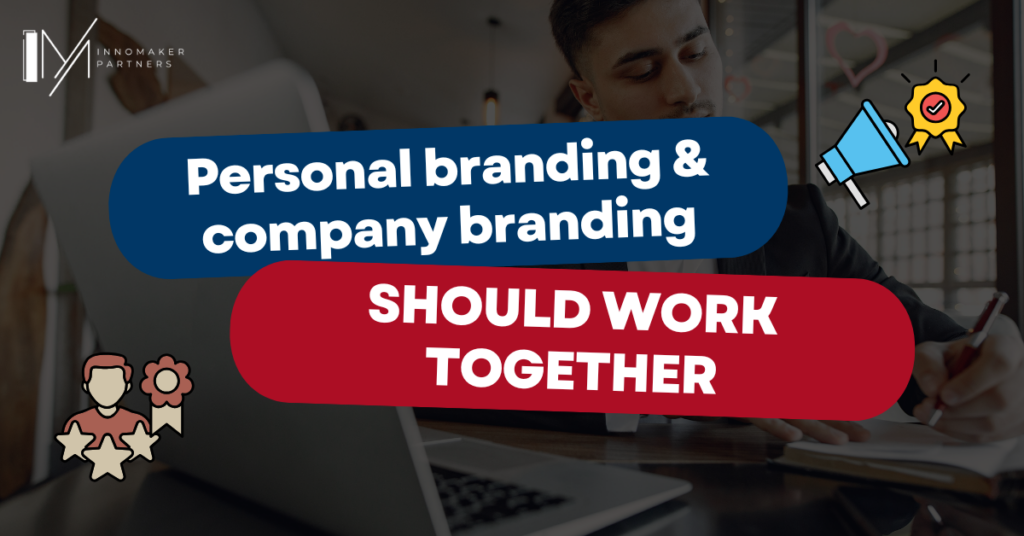
For most B2B startup founders before Series A, your personal brand should come first, or at minimum, be built in parallel with the company brand. The reason is structural: at early stage, buyers, investors, and partners evaluate the founder before the company. The two brands are not competing. But the sequencing matters, and most founders get it wrong.
This post breaks down when to lead with which, how the balance shifts at each stage, what the data actually says, and how to avoid the mistakes that waste both time and money.
Why personal branding matters more for B2B founders in 2026
The “personal brand vs. company brand” question has always existed, but three shifts have made it urgent for B2B startup founders in 2026.
First, LinkedIn’s algorithm now structurally favours personal profiles over company pages. According to 2026 LinkedIn benchmark data from Metricool, personal profiles achieve an average engagement rate of 2.60% compared to 1.74% for company pages.
Other analyses put the gap even wider: Linklulu’s 2026 data reports 3.85% for personal profiles versus 2.1% for company pages. And organic reach from company pages has dropped 60-66% since 2024, meaning the same post published from a founder’s profile will reach roughly 5-8 times more people than from the company page.
Second, B2B buying behaviour has shifted decisively toward self-directed research. HubSpot’s 2025 State of Sales report found that 71% of B2B buyers prefer independent research over talking to sales. Forrester’s 2024 Buyers’ Journey Survey found that 81% of buyers already have a preferred vendor before they make contact. These buyers are forming opinions from the content they encounter in their feed, and content from named humans consistently outperforms branded corporate content.
Third, trust has moved from institutions to individuals. The 2024 Edelman-LinkedIn B2B Thought Leadership Impact Report found that 75% of B2B decision-makers said thought leadership had led them to research a product or service they had not previously considered. And 62% said high-quality thought leadership comes from a prominent expert, not from a corporate brand voice.
For founders, this means: personal branding can’t sit on the sidelines anymore. The important part is building it in a way that creates trust now while gradually strengthening the company brand over time.
Should I build my personal brand or my company brand first as a B2B founder?
The short answer: personal brand first, company brand soon after. But “first” does not mean “only,” and the balance should shift deliberately as the company matures.
Here is the logic. At pre-seed and seed stage, your startup has no track record. No case studies. Possibly no website worth showing.
The only signal potential buyers, investors, and partners can evaluate is you: your thinking, your domain expertise, your conviction, your network. Research from Lenny Rachitsky’s B2B series, drawing on interviews with founders of Notion, Figma, Gong, Vanta, Retool, and Linear, found that the first 10 customers for essentially all of these companies came through founder networks, founder-led outbound, or founder-led content. Not through a company brand.
That doesn’t make the company brand unimportant.
At the early stage, there just isn’t much behind it yet for people to trust or evaluate. The founder’s credibility is the foundation. Building an expensive visual identity and company marketing machine at this stage risks what one branding strategist described well: spending heavily on branding only to pivot six months later and discovering that the brand is now disconnected from the actual business.
The smarter move is to lead with the founder’s voice to build trust, attention, and early demand, then gradually build company-level assets (website, case studies, content library, employer brand) as the business finds traction. The founder’s personal brand becomes the scaffolding on which the company brand is constructed.
This is what we see consistently at InnoMaker Partners, where we work as a fractional CMO + embedded execution team for early-stage B2B startups across Europe. Having built 8 company brands and 11 personal brands for founders, the sequencing question is one we help clients navigate from day one.
The founders who start with personal brand and deliberately layer company brand on top consistently outperform those who try to build both from scratch simultaneously, or worse, build the company brand first and bolt on personal branding later
How personal and company branding should change at each startup stage
The right split between personal and company branding depends on where the startup is. The table below synthesises guidance from multiple practitioner frameworks, investor perspectives, and our own experience building both brand types for European B2B startups.
| Stage | Personal brand emphasis | Company brand emphasis | What to focus on |
|---|---|---|---|
| Pre-product / pre-PMF | ~80% | ~20% | Founder publishes insight-driven content in their domain. Company brand exists only as a basic landing page and LinkedIn company page. Do not invest in expensive visual identity yet. |
| Post-MVP / pre-revenue | ~70% | ~30% | Founder drives attention; company-owned assets (website, email list, demo form) start capturing that attention. Begin building a simple but consistent visual identity. |
| Post-revenue / pre-Series A | ~50% | ~50% | Transition phase. Invest in company brand as an institutional credibility signal: original research published under the company name, customer case studies, and the LinkedIn company page for paid amplification. Cultivate 1-2 additional executive voices beyond the founder. |
| Post-Series A | ~30% | ~70% | Company brand becomes primary. The founder remains active but the company’s marketing engine runs independently. Employee advocacy programmes amplify the company brand through multiple personal voices. |
| Pre-exit (18-36 months out) | ~20% | ~80% | Aggressively rebalance. IP, customer relationships, content libraries, and audience assets must be demonstrably owned by the company, not the founder personally. |
These are approximate ratios, not rigid rules. A highly technical deep-tech founder selling to enterprise procurement may need to weight company credibility earlier. A consumer-facing founder-CEO may keep personal brand at 60%+ through Series B.
The underlying principle holds: lead with the trust signal that is most credible at each stage, and deliberately build the one that compounds longest.
What does the data say about personal profiles vs. company pages on LinkedIn?
The evidence is consistent across multiple independent studies, and the gap is large enough to be strategic rather than marginal.
The most influential study came from Refine Labs, which compared employee personal profiles to the company page over the same period: personal profiles drove 2.75 times more impressions per post and 5 times more engagement per post, despite employees having 46% fewer followers on average. This study has been replicated directionally by multiple sources since.
Digital Applied’s 2026 analysis found personal profiles generating 5-8 times the engagement of company pages for equivalent content. A88lab found personal LinkedIn profiles generating roughly 7 times more impressions and 4 times more engagement than company pages for B2B SaaS specifically.
The gap comes from how LinkedIn distributes content. Personal posts move through connection networks and feeds, while company-page content is shown mostly to people who already follow the brand. LinkedIn is built for people talking to people, not logos talking to audiences.
That said, the company page still has roles that personal profiles cannot fill.
LinkedIn advertising can only run from company pages. Employee advocacy programmes (which can generate 561% greater reach than company pages alone) are anchored to a company page. And branded search, which provides roughly 19 times the return on ad spend of generic search according to the LinkedIn B2B Institute and Ehrenberg-Bass research, is a company-brand asset, not a personal-brand asset.
The takeaway is simple: the founder’s profile should drive most of the organic reach early on, while the company page supports credibility, paid distribution, and long-term brand building.
Do investors actually care about a startups founder’s personal brand?
Yes, and the data on this is more robust than many founders realise.
Weber Shandwick’s CEO Reputation Premium research found that executives globally attribute an average of 45% of their company’s reputation to the CEO’s personal reputation. And 81% of senior executives said external CEO engagement is now a critical mandate for building company reputation.
At earlier stages, the effect is even more pronounced. When there is no product track record, no revenue history, and no brand equity, investors are evaluating the founder’s ability to communicate a vision, build conviction, and attract talent and customers.
A founder who is already visible in their domain, who has built an audience that engages with their thinking, provides a stronger signal than a pitch deck alone.
European VCs are often more understated about this than US investors, but the dynamic is the same. Sifted reported that James Routledge, founder of UK mental-health startup Sanctus, attracted his first 10 customers, angel investors, and national press coverage through personal content alone, before the company had meaningful brand recognition.
There is one notable counter-argument. Some European VC fund managers have expressed scepticism about the correlation between social media activity and actual performance, arguing that the most successful operators are sometimes the least visible online.
This is a fair point for fund managers specifically, but the preponderance of evidence for B2B startup founders points clearly in the other direction: visibility generates deal flow, talent interest, and buyer trust that directly supports company outcomes.
How should personal and company brands work together instead of competing?
This is the question most content on this topic fails to answer well, and it is where the real strategic value lies.
Personal and company brands should not run as parallel tracks with separate strategies. They should function as one integrated system where the founder’s voice drives attention and trust, and the company brand captures and compounds that attention into durable business equity.
Here is what that looks like in practice:
The founder should publish under their own name and speak in their own voice. The content should reflect how they actually think about the problems in their market, what they are learning while building the company, and where they stand on industry questions. Authenticity is non-negotiable here. Sifted’s reporting on European founders highlights the growing risk of AI-generated founder content that erodes the trust personal branding is supposed to build.
But every piece of founder content loosely points back to the company: a link to the website, a mention of a product feature, a reference to a customer outcome. The founder is the distribution channel; the company is the destination.
Major intellectual property, such as original frameworks, research, and methodologies, is published under the company brand and referenced by the founder. This is critical for long-term equity. If the founder personally owns every framework and insight, the company has no knowledge assets independent of the founder. If the company publishes the framework and the founder amplifies it, both brands benefit.
Customer contracts, email lists, and revenue relationships are always held by the company entity. This seems obvious, but it is surprisingly common for early-stage founders to run customer relationships through personal email, personal LinkedIn connections, or personal Calendly links with no company-level CRM or documentation.
We see this integration challenge regularly at InnoMaker Partners. When we work as a fractional CMO + embedded execution team for early-stage B2B startups, we often find that the founder’s personal brand and the company brand are either completely disconnected or non-existent. The founder posts occasionally on LinkedIn about general topics; the company page shares product updates to 200 followers. Neither drives pipeline.
The fix is always the same: connect the two into a single system with shared messaging, coordinated themes, and clear attribution paths from founder attention to company conversion.
The biggest personal and company branding mistakes for startup founders
There are three distinct failure modes & founders should know all three before committing to a strategy.
Over-investing in personal brand without building company equity
This is the most common mistake among founders who have read the “founder-led marketing” playbook but not the fine print. A strong personal brand that is never converted into transferable company assets creates what M&A advisors call a “key-person discount” at exit.
Multiple M&A advisory sources put this discount at 5-25% of enterprise value when revenue, customer relationships, or brand recognition are concentrated in one individual. iMerge Advisors describes pre-sale engagements where founders had to spend 9+ months transitioning customer relationships and documenting processes to avoid this discount.
The lesson: build your personal brand aggressively at early stage, but plan the transfer to company brand from day one.
Over-investing in company brand too early
This is the mistake founders make when they hire a branding agency before finding product-market fit. The result: a polished visual identity, an expensive website, and a corporate LinkedIn page that nobody follows, all disconnected from the founder who is still doing all the selling personally.
The 2024 Edelman Trust Barometer reinforces why this fails: buyers in 2024 explicitly distrust polished corporate marketing relative to content from named individuals. A pre-Series A startup with no founder visibility looks like a faceless vendor in a crowded category.
Running personal and company brands as disconnected tracks
This happens when a founder hires a ghostwriter for their LinkedIn and a separate agency for the company’s marketing, with no coordination between the two.
The founder builds an audience interested in leadership philosophy; the company talks about product features. The two don’t compound.
At exit, the founder owns the audience and the acquirer does not. The integrated model described above prevents this.
How personal branding differs for European startup founders
The advice changes in two meaningful ways:
First, there is more cultural friction around personal branding in Europe.
German-speaking markets carry a well-documented tendency toward modesty in professional self-presentation. Nordic countries have the Janteloven (Law of Jante), the cultural norm against individual prominence. Even in the UK, the approach tends to be more understated than the US default. Arvid Kahl, writing from a German background, described learning a “severe case of tall poppy syndrome” that made self-promotion feel uncomfortable.
This cultural friction is real, but it does not change the structural reality. LinkedIn’s algorithm works the same way in Berlin as in Boston.
B2B buyers in Munich and London research vendors through the same self-directed process as buyers in New York. The fastest-growing European B2B founders, including those at companies like Lovable, Personio, and Mentimeter, have all chosen to move past cultural reticence and use personal brand as a primary growth channel. Sifted profiled Anna Gullstrand of Mentimeter, who spends roughly two hours per week on LinkedIn content and explicitly credits it with generating leads that made a financial impact.
Second, European B2B founders selling to enterprise buyers in regulated sectors (healthcare, financial services, public sector, defence) may need to weight company brand earlier than the default framework suggests.
EU procurement processes, GDPR considerations, and the general preference for institutional credibility in these verticals mean that a strong company brand is not just a nice-to-have but a gating factor for being considered. In these contexts, a 50/50 split may be appropriate even at seed stage.
The bottom line: European founders should expect the personal branding journey to feel less natural than it does for US founders, especially in the first few months. The data says to do it anyway. The approach may need to be more substance-driven and less personality-driven than the US playbook, which actually tends to perform better on European LinkedIn anyway.
Real personal branding results from European B2B startups
We work with B2B founders across Europe on both personal and company brand-building, and the pattern is consistent. Here are two anonymised examples from InnoMaker Partners’ work:
One European B2B startup founder came to us with almost no online visibility. Within four weeks of launching a structured personal brand programme integrated into a broader marketing strategy, they went from unknown to ranking in the top 50 startups in their national market.
LinkedIn impressions increased by +1,800%, and a single piece of content in week two reached 20,000+ impressions organically, in a country with a total addressable social media market of roughly 10 million. The growth came from treating personal branding as part of the company’s broader marketing strategy, with clear links to positioning, messaging, and business goals from the start.
Another B2B founder in the AI space had been posting sporadically on LinkedIn for months with minimal traction. After building a strategic personal brand foundation and integrating ongoing content into the company’s marketing engine, the first two weeks of the programme outpaced the founder’s previous three months of solo posting.
Over 90 days: +1,330% increase in impressions, +8,300% in saves and sends, +344% in engagement, and +700% in website clicks from content. Again, the personal brand was not a separate project. It was embedded into the company’s marketing function.
These numbers illustrate the core principle: personal branding for startup founders works best when it is not a standalone exercise but a strategic layer within the company’s broader marketing operation.
If you are not sure where you stand today, our free Personal Brand Assessment gives you a structured view of your strengths, gaps, and concrete next steps in about four minutes.
Frequently asked questions
Can I build both a personal and company brand at the same time?
Yes, and at some stages you should. The question is not “either/or” but how to weight the investment.
At pre-revenue stage, lean 70-80% toward personal brand.
At post-revenue pre-Series A, move to roughly 50/50.
The key is to run them as one integrated system rather than two separate projects.
Founder content should drive attention toward company-owned assets, and company IP should be published under the company name and amplified by the founder.
What if my startup pivots after I have built a company brand?
This is one of the strongest arguments for leading with personal brand at early stage. If the company pivots, the founder’s domain credibility and audience remain intact.
A personal brand built around genuine expertise in a problem space survives product pivots. An expensive company brand built around a specific product positioning often does not.
Does personal branding work for technical founders who are not natural content creators?
Yes, but the format matters. Technical founders tend to perform well with content that shares original analysis, frameworks, or behind-the-scenes building narratives. The goal is not to act like an influencer, but to openly share how you approach the problems and ideas within your field.
The InnoMaker Partners personal brand programme was designed specifically for founders who are not natural self-promoters, using a structured process that starts with who you are and what drives you, not with content templates.
Will a strong personal brand hurt my startup’s valuation at exit?
Only if the personal brand is not deliberately connected to and transferable to the company. The key-person discount (5-25% of enterprise value) applies when business outcomes depend on one individual.
The mitigation is straightforward: publish IP under the company, hold contracts and customer relationships at the company level, and cultivate multiple visible voices in the team well before any exit.
How much time does personal branding actually take?
Consistently cited estimates from active founders range from 2-5 hours per week. Anna Gullstrand of Mentimeter has described spending roughly 2 hours per week, scheduling four posts weekly. The investment is not enormous. But the key is consistency and strategic alignment, not volume.
Is LinkedIn the only channel that matters for B2B founder personal branding?
LinkedIn is the primary channel for most B2B founders in 2026, but it is not the only one. Podcasts (both hosting and guesting), conference speaking, industry newsletters, and community participation all contribute.
However, LinkedIn remains the channel with the most favourable algorithmic distribution for personal content and the highest density of B2B decision-makers. For most European B2B founders, it is the right place to start.
How is personal branding different from thought leadership?
Thought leadership is a component of personal branding, not a synonym.
Personal branding includes your strategic narrative (who you are, what you stand for, why you are building what you are building), your visual and tonal consistency, and your presence across channels.
Thought leadership is the content layer: the insights, frameworks, and positions that demonstrate expertise. A strong personal brand includes thought leadership but also includes clarity of purpose, consistency of message, and the ability to connect authentically with your audience.
For a deeper dive, see our guide on how to build a personal brand without faking it.
Should I hire someone to manage my personal brand, or do it myself?
At the very beginning, doing it yourself is valuable because it forces clarity on your message and voice. Once you have found your voice and built a strategic foundation, working with a specialist who can systematise content production, maintain co
nsistency, and connect your personal brand to business outcomes makes sense. The worst option is outsourcing to a generic ghostwriter who does not understand your domain, your audience, or how personal and company branding connect. The content will feel inauthentic, and research suggests audiences notice.